How to organize for decentralized, autonomous and purposeful learning?
Becoming a ‘learning organization’ is on the top list of many business leaders (source). Whether Agile, Lean, Product-led, or autonomous ways of working, they all need a learning culture. I’d argue that purposeful, self-directed learning will help foster proactive learning behaviors as opposed to traditional ways of learning within organizations.
Sure, sometimes you can’t decentralize learning. You might need to learn top-down to clarify the strategic context across the firm. Or when you want to facilitate learning across silos in a community of practice, a chapter, or a forum. However, on the level of teams and employees, you might want to do less and let employees take ownership of their learning paths.
Problems to solve with Self-directed learning
Learning in organizations comes in many shapes, but the ways they’re traditionally organized stand in the way of becoming a learning organization. I want to explore five problems we can solve with self-directed learning:
- Learning as centrally organized overhead costs
- Standardized solutions unrealistically assume there is one way of doing things, no matter the context
- Learning paths foster misdirected learning motivation
- Most of LMS is a waste
- Traditional learning prevents a learning culture
Learning as centrally organized overhead costs
This is very common: the L&D team, as part of HR, supports the workforce in their learning by at least partly prescribing what people should learn, when they should learn it, and how they should learn it. As a central function, they design or coordinate learning for the people in the organization. The scope can range from 1 to 10+ L&D people for an org of 100-10.000+ people.
Consequently, this team has the impossible task of delivering/coordinating the right content at the right time in the right way to all employees. Logically, but unfortunately, they’ll therefore rely on standardized solutions that need to be relevant for many people, in many contexts, and over time.
Standardized solutions unrealistically assume there is one way of doing things, no matter the context.
Deciding centrally what should be learned unrealistically assumes equal needs across the organization and wastefully creates static learning content with a decreasing half-life.
For example, learning material is based on what is needed for specific (standardized) roles or functions. However, standardized solutions assume there is one best way of doing things, no matter the context. So people with the same functions but in different teams are considered to face the same challenges and have similar problems to solve. This, however, is often different (see the book Holacracy, where this argument applies to many more situations in modern-day bureaucracies).
On top of that, when markets, consumers, or laws change, people have different learning needs. Adjusting for this is often a bureaucratic nightmare.
Finally and more generally, having a central team that decides and designs what you need to learn invites you to outsource the accountability of your learning, actually decreasing the proactive learning behaviors many organizations want to foster. We might hypothesize that the level of output generated by a centrally organized L&D team negatively correlates with the proactive learning behaviors of employees.
Learning paths foster misdirected learning motivation
When curated learning paths guide employees in their learning journey to become successful, they do not have to think about what to learn and when.
To complicate things, as most learning is tied to functions and the level of these functions, promotions are linked to these learning paths. “You need to learn XYZ before you can get a promotion to the next level.”
This misdirects the motivation for learning as people want to learn things, not to be a better team player, become a more effective problem-solver, or serve the customer better. Learning becomes (at least partly) directed to conform better to a function and/or get to the next flight level on the hierarchical ladder.
Most of LMS is a waste.
You’ll find Learning Management Systems (LMS) in larger organizations, the marketplace with learning material employees should choose from. Smart people populating the LMS try to cater to different learning styles, optimize for the ‘learning experience,’ and make the content as engaging as possible. Still, based on my experience, I hypothesize that 80% of this content is hardly used unless diligently pushed to employees (which is not a sustainable method). (I realize this might be a bit of a radical standpoint as the LMS market is projected to grow enormously to almost $50B by 2030, source).
Also, the content of this learning marketplace is often outdated and under par compared to what you can find on the internet (free or paid). It’s hard to beat an online boot camp on AI organized by MIT and Google with learning material on an LMS.
The point is that people can be very resourceful if they are motivated to solve a challenging problem. Or at least you want to foster this resourcefulness. This demands less central coordination or massive dust-gathering libraries in an LMS. There are better ways to cater to high-quality learning.
Traditional learning prevents a learning culture.
Traditionally, learning is often based on permission. If you want to do training or focus on developing a particular skill, you need some form of authorization either from your manager or HR. Raising barriers for people to pursue learning desires is a bad practice in my book if you want to cultivate a learning culture.
Towards purposeful, self-directed learning for progressive organizations
What if we remove all governance, processes, structures, bureaucracy, and learning systems? Apart from saving many costs, how do you foster high-quality learning?
Self-directed learning is one way to enable purposeful, adaptive, and autonomous learning. ‘It’s a practice of workplace learning where individuals and groups take responsibility for their learning in different situations, aiming to develop their competency’ (source). It’s a practice fitting in the non-hierarchical structures more and more organizations are pivoting towards (source). Self-directed learning allows people to take full ownership of their learning and development.
Learning cycles & learning contracts
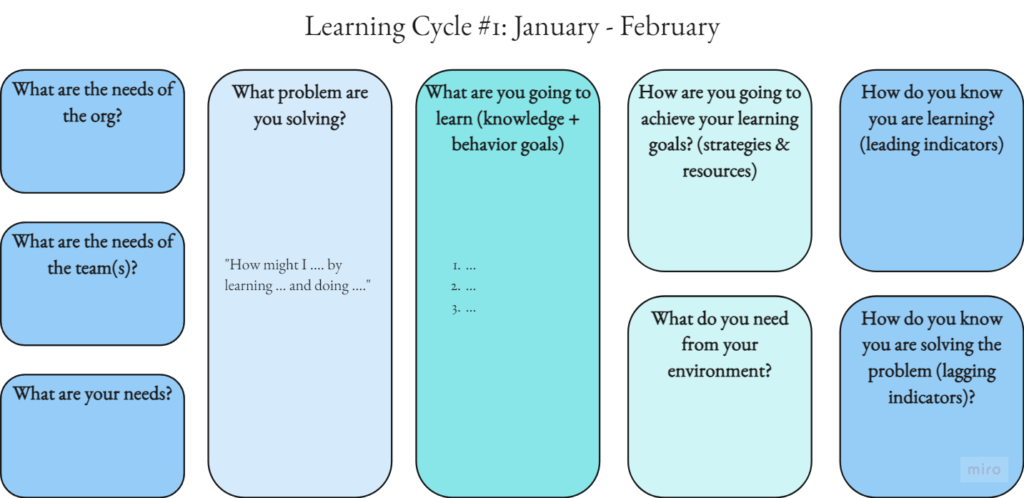
Learning cycles are at the core of purposeful, self-directed learning. Every 1-3 months, depending on the needs of the individual, team, and org at that moment, you look ahead and (re)define what you want to learn and how you’ll accomplish this. Using a learning contract can help structure this. Also, self-directed learning is not done in isolation. You seek input from others, validate ideas, and discuss your learning contract with relevant people within or even outside your organization.
To make learning purposeful, your learning goals should ideally represent some needs of your org, your team, and yourself. For example, the business might see opportunities to apply AI and encourage people to experiment with this. No one in your team has much experience, and you are eager to learn more about it. Often, though, these needs aren’t very explicit, and you must figure them out or experiment with them.
See below for an easy-to-use template to help you (and your team) kick off a self-directed learning experiment (feel free to contact me to discuss experiment designs!)
The many benefits of purposeful, self-directed learning
In sum, applying self-directed learning on the level where the work gets done enables continuous and relevant learning, resourcefulness, and creativity (source). It ensures learning is dynamic and purposeful: it self-adjusts based on what is needed for a team to be successful. It reinforces a learning culture, as it places the responsibility and ownership of learning in the hands of the individual while being collectively supported. It’s also cost-effective as you need less overhead, governance, bureaucracy, and IT systems (but it’s not for free! See next section).
How to enable purposeful, self-directed learning?
Enthusiastically decentralizing parts of the L&D overhead and telling people to figure out the learning stuff themselves is like firing team leads and saying to teams, “From now on, you are self-managed teams.” Doesn’t work that way. People need to acclimate to the new situation: they need to be able and be enabled to self-directed learning. Here are some pointers to take into account:
- Transferring the responsibility and the organization of learning to individuals can be experienced as burdensome and can backfire if people are not supported to carry this responsibility (source). Helping them to work with a learning contract, a lightweight process (learning cycles), and some facilitation/coaching goes a long way here.
- Clarity about the business purpose, strategy, and challenges gives context for teams and individuals to base learning goals on.
- Similarly, clarity about what makes a team successful gives similar context. Teams can assess gaps in knowledge, skills, or experiences, which may serve as input for learning goals.
- Train teams to help each other in their learning goals. Fostering a safe space for learning is cliche but critical.
- Recognize and reward the outcomes of learning cycles (source).
Start small; try it out for yourself or on your team.
Like many self-management patterns, you need to adopt them in your specific context and shape them into something uniquely befitting for you, your team, and your org. And this starts with experimenting on a small scale. Sharing articles like this with your team and experimenting with learning cycles and contracts yourself or with (some) team members are great ways to build that self-directed learning muscle. I’m curious where your explorations will take you.
Enjoy the ride, and drop a line with your thoughts.
Mike